
Home | Gadget | Fuzzy | Lecturer | Power | Transceiver
Find more type here...
8 Watt Fluorescent Lamp Inverter-2
by David Bradbury
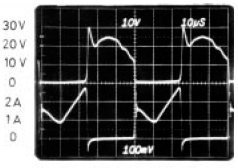
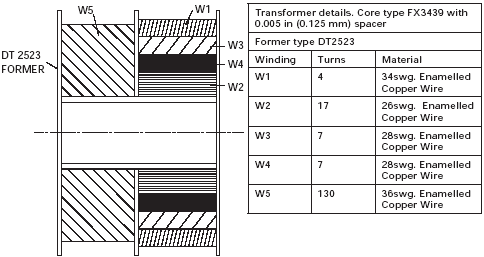
Figure 2 ZTX652 VCE and IE waveforms. Figure 3 Transformer winding detail
Once the tube has struck, it loads the transformer heavily, swamping this ringing action and so greatly reducing the peak voltage induced across W2 and the transistor. This extends the non-conducting period of the inverter cycle and during this period, energy stored in the transformer in the form of magnetising current is dumped into the fluorescent tube. When all of this energy has been dumped, the voltage on the transistor collector falls and it switches on once more. The voltage required to pass current through the tube has now fallen enough for it to conduct during both half cycles of inverter oscillation. Thus when the transistor now turns on, it both drives
the fluorescent tube directly and also stores energy in the transformer which drives the tube during the transistor’s non-conducting period. The current passed through the tube is controlled by the transformer’s leakage inductance and also a series connected 0.015mF capacitor. Waveforms of the transistor’s collector voltage and emitter current under normal operating conditions are given in Figure 2. The 2.2W resistor and 0.22mF capacitor included in the circuit give the inverter a rapid turn-off characteristic, which limits the power dissipation in the transistor to approximately 500mW with the tube lit and with a 12Vsupply.However the power dissipation in the transistor is much higher if the tube is broken or removed. Taking the worst case conditions of 16.5V supply and no tube, the transistor will dissipate approximately 1.5W. Thus if the inverter may be operated under these conditions as for instance Public Transport applications etc., the transistor should be clamped to a heatsink better than 15 °C/W. Where the inverter will not remain energised if the tube does not strike, no heatsink is necessary. Similar higher power designs are possible using the ZTX853 4A DC rated part, which is available in the E-Line package, (enhanced TO92) and also in the surface mount SOT223 package as the FZT853.
Construction
Apart from keeping component lead lengths short, the layout of the circuit is not critical. Care should be taken however in winding the transformer (see figure 3). It is advisable to mount the unit in a metal case as this will provide RF screening of the inverter and also provides a ground plane for the fluorescent tube which significantly reduces its striking voltage. The case could also be use dasheatsinking for the ZTX652 transistor when required.
Related topic